
Showing posts with label whiteboard. Show all posts
Showing posts with label whiteboard. Show all posts
Monday, April 17, 2017


Friday, April 14, 2017


Wednesday, April 12, 2017
Friday, March 31, 2017

Monday, March 27, 2017

Friday, March 10, 2017
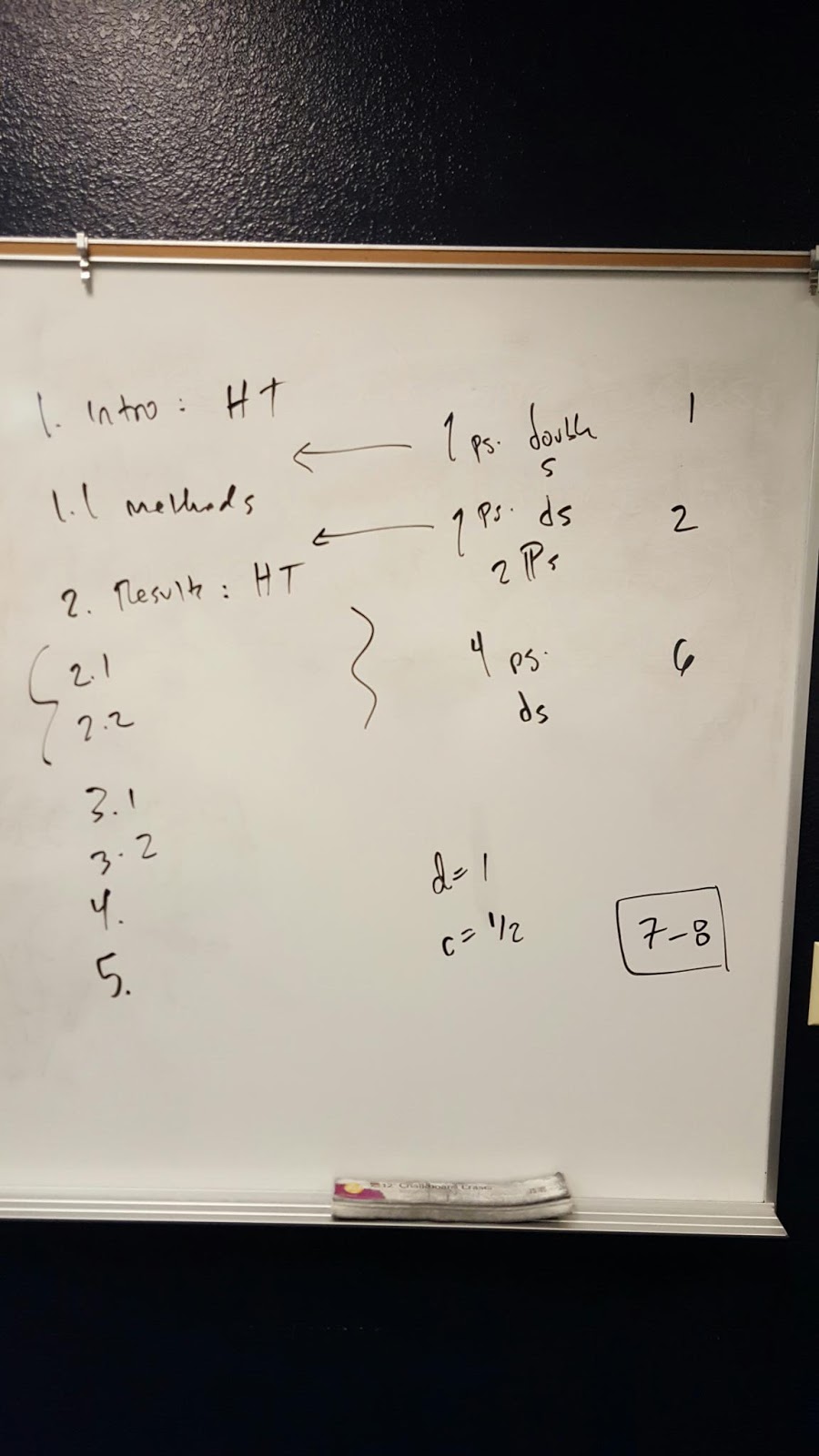
Arrangement of the sections
Notice the baby intro/road map first. I said on Friday that I don't mind whether your research question is embedded into the road map paragraph or not, but it definitely needs to be there. In the AJPH and thus AMA literature review we looked at, the research question is in bullet points. But in the APA ones, they seem to be more embedded.
Also notice how the sections go
1. Introduction
Technically the research question + road map goes here.
1.1. Methods/Search Strategy
2. Results
2.1. Theme One (don't call it this; it has to have a helpful title [see rubric])
2.2. Theme Two
2.3. Etc.
2.4. Etc.
3. Discussion
And, also technically, the answer to your research question goes here.Also notice how the verbs will tend to be more passive in the intro and more active in the results section.

Wednesday, March 8, 2017
This is one way to synthesize
In this photo, I discuss one way to synthesize. In class, I talked about how one good way to write is to
- write the source's result at the top (*) (see picture closest to the bottom of this post)
- notice as many things as you can about the source, i.e., how the results relate to the method, argument, evidence, setting/context (context of the study, not to the context of everyday life in general), etc.
- break up the things you notice each into paragraphs of their own (again, see picture closest to bottom of this post)
- craft them with topic sentences each of their own
- re-craft the original source you started with, that is, with a topic sentence, too (refer back to asterisk *)
- check to see if you can consciously apply a topoi to derive greater control over the order/ordering of the paragraphs
- re-write what's interesting about the source, or each one of your observations, by triangulating the observation with your research question and the context of the source itself, that is, with the topoi in mind: this is one way to make your prose more specific (see picture closest to top in this post)


You're not writing an intro or a conclusion, but...
This was a great question after class that I did not make it to in the discussion today. The question was, "So, you were working with an intro in class, but you also said that we're not required to write one--what's up with that?" I could see how this would be confusing. I do not want you to write a formal introduction or conclusion. What is different about the rubric, though, is I say you need to, that is, prior to the writing of the results section, insert your research question and lay out what your strategy is (look to the middle of this document to see what I mean; look for the "RQ"; whenever I write "RQ," that's short for "research question"). This only need be a paragraph, and, as I say in this picture (below), it can be informal. Also conclude like this as well. In the rubric, I say something like, you need an 11th result, and then also a strategy to begin with. The 11th result should be in the discussion section. But you weren't required to write the discussion section, obviously, which is why I just want to you make the section title and then informally write what you think it all means, i.e., whether, to what extent, and how your research question was answered, plus a brief contextualization. Thus, while you do need an intro and a conclusion, they can be informal/colloquial and shouldn't be in the results section.
If you go to the the bottom most picture, you'll see how research questions are actually embedded into a published, AJPH literature review, and then even how there's a little paragraph after that. I just want you to make what I called in a former post the "baby intro": i.e., just write a brief paragraph wherein you strategize and wherein you make your strategy available for critique. You don't have to commit to this strategy. But I want you to discuss what you intend for your results section to do, and the way in which you intend for that section to do it (= strategy). Informal, low stakes.
Do the same thing for the conclusion. Just unwind for a little bit (see second to last picture) and talk about what you think it all means. But I'd like for you to think about what the 11th result would be: that is, what conclusion you yourself come to after having worked with the other 10 sources--but more importantly, whether, to what extent, and how your research question was answered. Do that in a section entitled "discussion" (see second to last picture). You can be informal here. Unwind. But do conclude. Wrap up. Just think for a second, but, while your doing that, try to draw an inference as to the meaning of all 10 results taken as a whole.


How the results relates to the discussion section
This is getting a little ahead of ourselves, but, I was asked a question as to what to do with so-called "straggler sources": sources that don't exactly belong in the results section of the paper, but are interesting enough to keep. Save them. Don't think that everything, every source, really, belongs in the results section. Not every source does. The purpose of the discussion section is ask whether x is consistent with y.
x = the 11th result.
y = the field of public health in general, or, in this case, whatever else you know and find interesting. this is also where the A Very Short Introduction to Public Health will come in handy.
Or, is
x, when x = my 10 results, plus my own conclusion as to their broader meaning, how does x fit in with y, when y = everything else I know about public health, or about the world in general

Monday, March 6, 2017
What if all my results say the same thing?

then emphasize the relation between method and results, or the context of the study itself--basically, the setting in which the research took place, and how the researcher arrived at the results
Wednesday, March 1, 2017

Saturday, February 18, 2017


Subscribe to:
Posts (Atom)